Icelandic Police
Operation NapoleonThe Icelandic Police provide the novel’s grounded, procedural response to a crisis that repeatedly escapes ordinary law enforcement. They examine a suspicious death in Kristín’s flat, pursue a violent incident in central Reykjavík, and try to question U.S. military representatives. Their work produces concrete clues and a measure of trust with Kristín, but it also exposes the limits of their access: the military operation on Vatnajökull Glacier is concealed behind official evasions and security claims.
Investigation and first response
The police are drawn into the case after a neighbour reports that a distressed young woman had entered his family home just before midnight, asked to use the telephone, spoken incoherently about a murder, borrowed clothes, and disappeared. More than three hours passed before he reported the incident, largely because his wife urged him to do so. The delay makes the first account indirect and uncertain: the officers must work from a witness’s recollection, a telephone number, and a description rather than from Kristín herself.
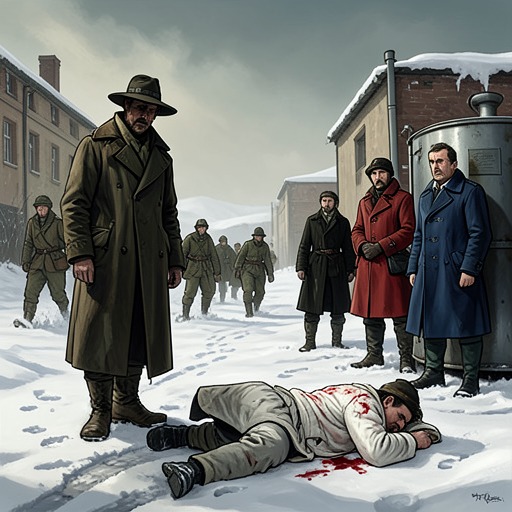
Checking the number leads the police to an address in the same neighbourhood. No one answers at the two-storey maisonette, and the upstairs occupants say they had been out all evening. A small hole in Kristín’s door, possibly made by a bullet, prompts the officers to call a locksmith. Inside, they find a man slumped over a desk. The sequence is methodical, but the apparent quiet of the room makes the discovery more, not less, troubling.
The older detective identifies the dead man from his business card as Runólfur Zóphaníasson, whose stated line of work is import-export. His wallet also contains a driving licence, cash, restaurant receipts, and debit and credit cards. The furniture is in place, pictures hang straight, and nothing on the surfaces appears disturbed; no weapon is immediately evident elsewhere in the flat. Yet the body has a bullet wound in the forehead and a gun in his hand. The detective questions whether the wound’s angle fits suicide, turning the apparent explanation into an investigative problem rather than accepting the scene at face value.
The city-centre shooting
By the following evening, the same two detectives are at an Irish pub surrounded by the aftermath of another violent incident. Police tape cordons off the area; floodlights illuminate the premises and street, police cars flash nearby, and reporters and photographers circle a crowd of onlookers. Ripley and one fisherman have been admitted to hospital. The older detective’s comparison of the scene to a spaghetti western conveys the spectacle of the crime scene, while his younger colleague confirms that Kristín was there and that witness statements match the picture the police have of her.
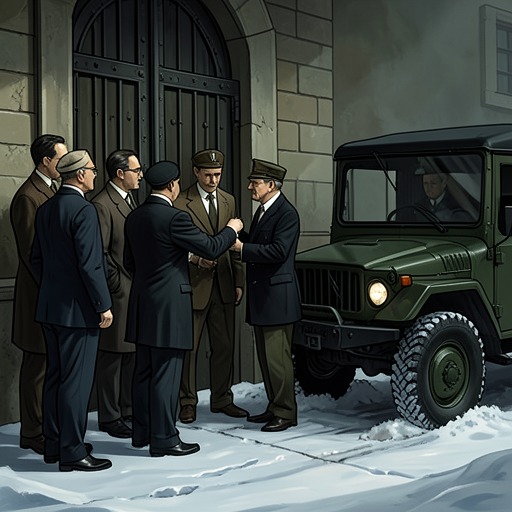
The detectives’ inquiry reaches the U.S. Embassy, Reykjavík, on Laufásvegur. The ambassador and attaché are out of the country, and the chief press officer is indisposed, so the officers are referred to Immanuel Wesson, the highest-ranking officer available in the ambassador’s absence. They wait an hour and fifteen minutes in an anteroom before he receives them. The younger detective conducts the questioning because his partner has a poor command of English; a thin young man named Smith stands behind the general at a carefully judged distance.
The police tell Immanuel Wesson that a shooting in the city centre involved a vehicle registered to the United States Defense Force at Keflavík and that an American citizen was injured. The embassy visit is an attempt to pursue an ordinary investigative lead across an institutional boundary. The officers can state the incident and ask about it, but the scene offers no indication that they obtain the information they need about the military connection.
Kristín’s account and the investigation’s limits
The detective investigating the shooting later speaks with Kristín by telephone while she is at the foot of Vatnajökull Glacier. He has listened to her account of the extraordinary events and why she did not contact the police sooner. Rather than challenge her and risk ending the call, he responds as though he takes her seriously. The force is working around the clock on the shooting and murder, and the detective’s practical caution becomes part of the interview: keeping Kristín talking may matter more than pressing her immediately.
He tells her that the Ministry had considered the possibility that she killed Runólfur and went into hiding, while also judging that, if she had done so, she might have acted in self-defence because Runólfur had threatened her. Kristín rejects any connection between Runólfur and the larger events, and says she believes he saved her life. The distinction matters to her account: the man found dead in her home is not, in her understanding, part of the operation she is trying to uncover.
The detective also admits that the police know nothing about the other man involved in the events. Their visit to the embassy has yielded no answers, though they are convinced the Americans have something to hide. He asks Kristín for help. She identifies a plane wreck on Vatnajökull Glacier as the subject of the secret operation and gives him the one name she has, Ratoff, as a possible person in charge. The exchange briefly turns the relationship between investigator and witness into cooperation: the police can offer a listening ear and pursue the public crimes, while Kristín has information unavailable to them.
Police work beside a concealed operation
The difference between the police investigation and the military operation is sharpened by disclosures made elsewhere in the story. Vytautas Carr tells a U.S. secretary that much of the gold associated with the wreck originated in concentration camps; later, Immanuel Wesson warns Icelandic officials that an old German bomb is on the glacier and urges them to call the rescue team back. Military personnel also tell a pilot that the World War II aircraft is safe and that they have found no bomb. These claims and counterclaims frame the security crisis, but the police scenes do not show the officers being given this information. Their knowledge remains partial, assembled from the shooting, Kristín’s account, and their unsuccessful effort to question the embassy.
The Icelandic Police are therefore neither absent nor all-powerful. They investigate the death and shooting, inspect physical evidence, follow witness accounts, and attempt to question the U.S. presence through its available representative. Their procedures can identify contradictions and keep a channel open to Kristín, but they cannot compel disclosure about the glacier operation in the scenes shown. The contrast gives their work its significance: against secret military claims and restricted information, the detectives continue to treat bodies, witnesses, and inconsistencies as evidence.